![]()
Home | Newsletter | Calendar | Contact Wheels | Pictures | News | Membership
One | Two | Three | Four | Five | Six | Seven | Eight | Nine | Ten | Eleven | Next
By Lloyd E. Stagner and TRAINS Magazine
This Italian valve gear had been developed by Arturo Caprotti (1881-1938) in 1915 and tested first in the U.S. on Baltimore Ohio 2-8-0 No. 2722, starting in March 1927. B&O also had newly built 4-6-2 No. 5320, President Cleveland, equipped with the Caprotti valves in 1928; however, the valve gear was removed in 1929, before 3764 was delivered to the Santa Fe. Other American engines fitted with the valve motion included Pennsy's "Mussolini" K5 Pacific 5699, Reading 4-6-0 616 and 2-10-2 3010, Southern Pacific 2-10-2 3769, and Union Pacific 4-8-2 7006.
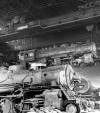
Equipping the last engine of the Santa Fe 4-8-4 order with poppet valves cost a premium of $1977.73 over the, $102,302.06 cost of Nos. 3761-3763. Not until January 1931,did Santa Fe make a test with a dynamometer car to meter 3764. Results were not noteworthy. Although Baldwin had advertised "important savings" could be expected with Caprotti poppet valves, 3764 while handling No. 19, The Chief, on three test runs from La Junta to Albuquerque, burned 160.3 pounds of coal per 1000 ton miles, compared with 3751's 138.6 pounds on its 1928 test. Evaporation favored 3751, with 6.74 pounds of water evaporated per pound of coal compared with 3764's average of 6.16. Possibly winter weather conditions adversely affected 3764, but the Caprotti gear simply was too light for the heavy service required on big locomotives such as 3764, and it had the further disadvantage of requiring specialized maintenance, which was never easily achieved at most enginehouses. No. 3764 was shifted to fast freight service between La Junta and Newton, Kans., 355.3 miles, between August 1932 and August 1933. The Caprotti valve gear was removed and new cylinders with Walschaerts valve gear applied at the Albuquerque shop in 1934.
With 14 4-8-4's available, a pool was set up with the engines working out of Albuquerque east to La Junta, thence west back through Albuquerque to Winslow, 636.5 miles. After completing a westbound run to Winslow, the engine would be cut out at Albuquerque on the eastbound leg for inspection, boiler wash, and necessary running repairs, before resuming its circuit. The 3751 class also handled Winslow-Clovis, N. Mex., runs, 503.5 miles, on the route via Amarillo. The pre-depression peak of AT&SF passenger operations saw seven trains in each direction between Chicago and California. Five, including the crack Chief and the all-Pullman Califomia Limited, operated via La Junta; the Scout and the Missionary ran via Clovis. The most difficult schedule was that of Fast Mail Express No. 7, which handled a maximum of 16 cars at an average speed of 39.1 mph, with 10 regular stops between La Junta and Winslow. No. 19, the westbound Chief, was the fastest train with a 38.4 mph average, closely followed by No. 4, the California Limited, averaging 37.9 mph. Passenger trains not protected by the 3751-class 4-8-4 engines used the 3700-class 4-8-2's, which had been operating through on the same circuit since 1926.
The Santa Fe acquired its first 3600 h.p. passenger diesel in September 1935 and introduced the Super Chief on a 39-hour, 45-minute, once-a-week schedule between Chicago and Los Angeles on May 12, 1936. It was expected the diesel locomotive would not always be available, so John Purcell, head of the Santa Fe mechancial department, ordered two 3400-class 4-6-2's, one 3450-class 4-6-4, and two 3751-class 4-8-4's improved to standards that would permit them to maintain Super Chief time in event of diesel failure.
No. 3751 was selected for conversion to oil burning and assignment between Winslow and Los Angeles. The existing tender was fitted with an oil tank of 5071 gallons' capacity and the Santa Fe standard Booth burner applied to the engine. The Santa Fe patent Batz engine truck with coil springs was applied, and the valve travel was shortened to permit operation at a maximum of 90 mph instead of 65 mph, to which the 3751's had been restricted since delivery. No. 3753 was equipped with the Batz engine truck and shorter valve travel and assigned between La Junta and Albuquerque. On this run, it was necessary to take coal at Trinidad and water at that station, Raton, Las Vegas, and Lamy. On the Winslow-Los Angeles run, oil was taken at Hackberry, Ariz., and water at six stops. Purcell's instructions of April 18, 1936, included the following: "Special attention should be given these engines after they go in service to see that they are kept in first-class shape. The time is fast, and engine trucks, tank trucks, springs, driving journals, wheels, and everything must be in first class condition when the engine leaves the roundhouse. New. cakes of grease should be applied to each driving box cellar and all engine driving and tank truck springs, also engine truck ,and tank boxes should be gone over and put in first-class shape. Care should be exercised to see that there are no sharp flanges on any of the engine and truck wheels."
After diesels 2 and 2A were received from EMC in June 1937, the steam protection power for the Super Chief was dispensed with in October and the engines returned to pool service. During the time they were assigned to protection ,service, they were used to the fullest extent possible on other trains, but available on standby on the day the weekly Super Chief passed over their districts. Santa Fe ordered 40 new 20,000-gallon water, 7107 gallon-oil capacity tenders from Baldwin in 1937, of which the 25 assigned to passenger engines were equipped with roller bearings. Fourteen were placed behind the 3751 class, and the remaining 13 engines converted to oil burners at the Albuquerque shop between October 1937 and March 1938. With the 1934-1937 speedups of passenger train schedules, oil firing permitted a reduction in the number of fuel stops and eliminated the need to clean fires and dump ash pans.
By February 20, 1938, the Chief was operating on a 49-hour, 49-minute schedule westbound and 47 hours, 55 minutes eastbound, compared with 56 hours in 1933 and 63 hours when inaugurated in 1926. No. 7 was faster, with 47 hours, 35 minutes, and eastbound No. 8 took 53 hours, 20 minutes. The times of the other three Chicago-Los Angeles trains, California Limited, Scout, and Grand Canyon Limited varied from 58 hours to slightly over 60 hours, but made more and longer station stops.